At Quaffee, we have accumulated more than a decade of roast data across hundereds of production batches. Alongside roast information, we have recorded ambient temperature and humidity readings for many of those roasts.
Roasters often ask whether weather conditions affect roast outcomes. To investigate, we analysed historical roasting data and compared environmental conditions against several key roast metrics:
- Weight loss percentage
- Time to first crack
- Total roast time
- Development percentage
We excluded records with missing environmental data and filtered obvious sensor anomalies to improve the quality of the analysis.
What We Found
The data suggests that ambient temperature has a measurable effect on roast progression. Humidity, on the other hand, appears to have a much smaller influence.
This does not mean humidity has no effect. However, within our production data, temperature showed a much clearer relationship with roast behaviour.
Humidity: A Smaller Effect Than Expected
We compared low-humidity and high-humidity roasting conditions across historical roast records. We expected to see meaningful differences in weight loss or development percentage.
Instead, the differences were small.

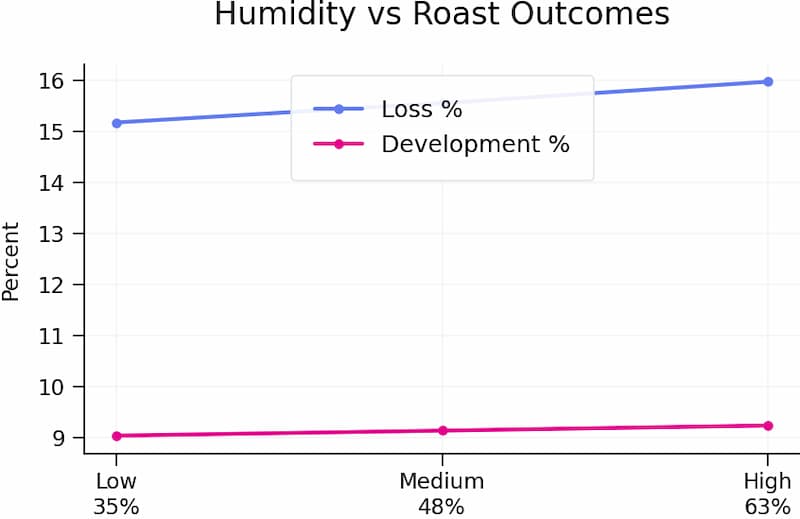
For one of our largest coffee datasets, average development percentage increased only slightly as humidity increased. Weight loss percentage also changed very little.
More importantly, the direction of the effect was not consistent across different coffees. Some coffees showed slightly higher losses at higher humidity. Others showed slightly lower losses. While we are not 100% sure why this is the case it may be related to the moisture level of the green bean, or even the moisture activity levels.
The practical conclusion is straightforward:
Humidity appears to influence roasts, but its effect is relatively small compared with the normal variation seen in production roasting.
Temperature Produced a Clearer Signal
Ambient temperature told a different story.
When we grouped roasts by ambient temperature, several clear patterns emerged.

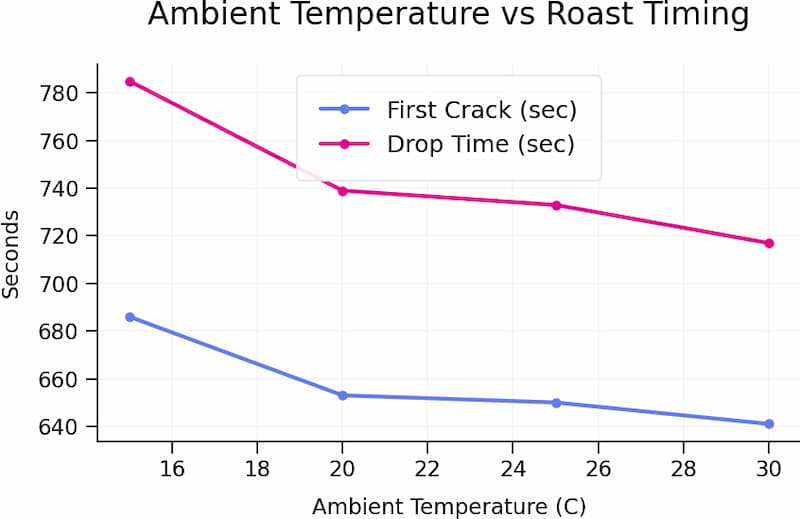
As ambient temperature increased:
- First crack occurred sooner.
- Total roast time became shorter.
- The roaster reached key milestones quicker.
Comparing cooler and warmer roasting conditions:
- First crack occurred approximately 45 seconds earlier.
- Total roast duration decreased by approximately 68 seconds.
That is a meaningful change in a production roasting environment.
Development Percentage Also Changed
The development percentage followed the same pattern.

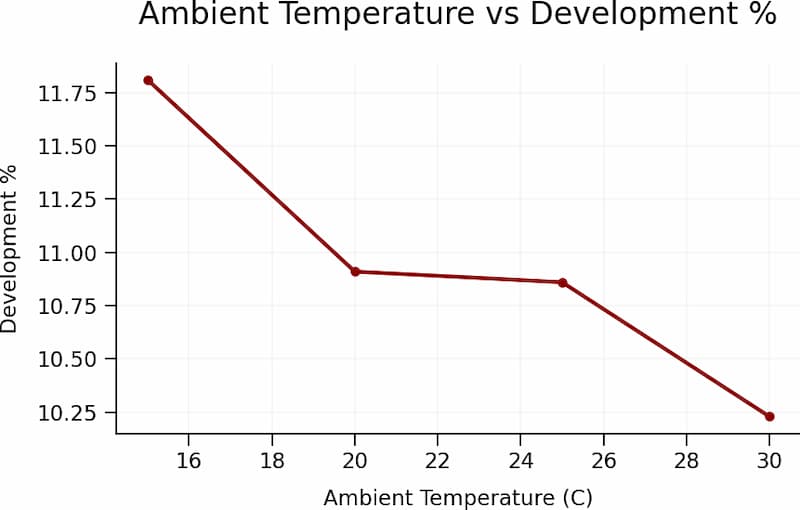
As ambient temperatures increased from roughly 15°C to 30°C, development percentage decreased from approximately 11.8% to 10.2%.
Although the change appears small, it was consistent across a large number of roasts.
This suggests that warmer roasting conditions naturally accelerate roast progression, reducing the proportion of time spent in development unless profile adjustments are made.
What This Means for Roasters
If you only monitor one environmental variable, our data suggests ambient temperature deserves the most attention.
Higher ambient temperatures were associated with:
- Earlier first crack.
- Shorter total roast times.
- Lower development percentages.
Humidity showed a far weaker relationship with roast outcomes and did not demonstrate a consistent pattern across coffees.
For that reason, seasonal profile adjustments may be more effective when based on ambient temperature rather than humidity alone.
Final Thoughts
Coffee roasting remains influenced by many factors, including green coffee age, moisture content, density, processing method and roast profile decisions.
However, after reviewing more than a decade of roasting data, a consistent pattern emerged.
Ambient temperature appears to have a measurable effect on roast timing and development. Humidity appears to play a much smaller role.
We will continue collecting environmental data and revisiting the analysis as the dataset grows. It will be interesting to see whether individual origins or processing methods respond differently to environmental conditions over time.