

Colombia
Colombia has grown coffee for more than 100 years. Today, coffee supports hundreds of thousands of farming families across the country. In fact, most Colombian coffee comes from smallholder farmers who manage relatively small farms.
Much of Colombia’s success comes from its geography. The country sits close to the equator and benefits from a stable climate throughout the year. In addition, the Andes Mountains run through Colombia in three separate ranges. These mountains create different microclimates, elevations and growing conditions. As a result, farmers can produce coffee in many regions throughout the year.
When it comes to flavour, Colombian coffees often deliver balance and consistency. Depending on the region, you may find notes of chocolate, caramel, citrus or stone fruit. However, most Colombian coffees share a clean profile, structured sweetness and bright acidity. Because of this combination, Colombia remains one of the world’s most respected specialty coffee origins.
Sugarcane Decaffeination
This coffee uses the sugarcane decaffeination process, also known as EA Decaf. Unlike some decaffeination methods, this process uses ethyl acetate derived from fermented sugarcane. We prefer the sugarcane process because it preserves flavour well. In addition, it often maintains more body and sweetness than some other decaffeination methods. This allows the coffee’s natural character to remain clear in the cup.
Process
The process begins with sugarcane molasses. Fermentation produces ethanol, which then serves as the basis for naturally derived ethyl acetate. Interestingly, ethyl acetate occurs naturally in many fruits, wines and fermented foods.
Next, a specialised decaffeination facility receives the green coffee. Technicians steam and hydrate the beans to prepare them for decaffeination. They then wash the coffee with the sugarcane-derived ethyl acetate.
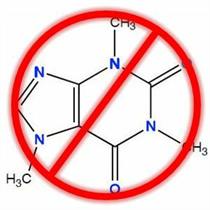
The ethyl acetate bonds with the caffeine and removes it from the coffee. At the same time, it helps preserve many of the compounds responsible for flavour, aroma and body. As a result, the coffee retains much of its original character.
After decaffeination, technicians rinse, dry and stabilise the coffee. They then check the coffee for moisture content, caffeine levels and overall quality before preparing it for export.
The process does not add sugar to the coffee. However, removing caffeine reduces some of the bitterness found in the original bean. As a result, caramel, fruit and sugar-browning notes often become more noticeable. Consequently, many sugarcane decafs taste slightly sweeter and more rounded than their caffeinated counterparts.
Antioquia
Antioquia is one of Colombia’s largest coffee-producing regions and has a long history of coffee cultivation. The department stretches across the central Andes and includes a wide range of elevations, landscapes and growing environments.
Coffee farms in Antioquia commonly sit between 1,300 and 2,200 metres above sea level. The region experiences moderate temperatures, regular rainfall and good sunlight throughout the year. These conditions support slow cherry development, which helps build sweetness and complexity in the coffee.
The soils are mainly volcanic in origin and contain good levels of organic matter. Combined with steep mountain terrain and careful farming practices, these conditions support healthy coffee plants and consistent quality.
Antioquia coffees are often known for balance rather than extreme acidity. Expect structured sweetness, chocolate notes, caramel, nuts and gentle fruit character. Higher-altitude lots can show brighter citrus flavours and greater complexity while maintaining a clean, approachable cup profile.
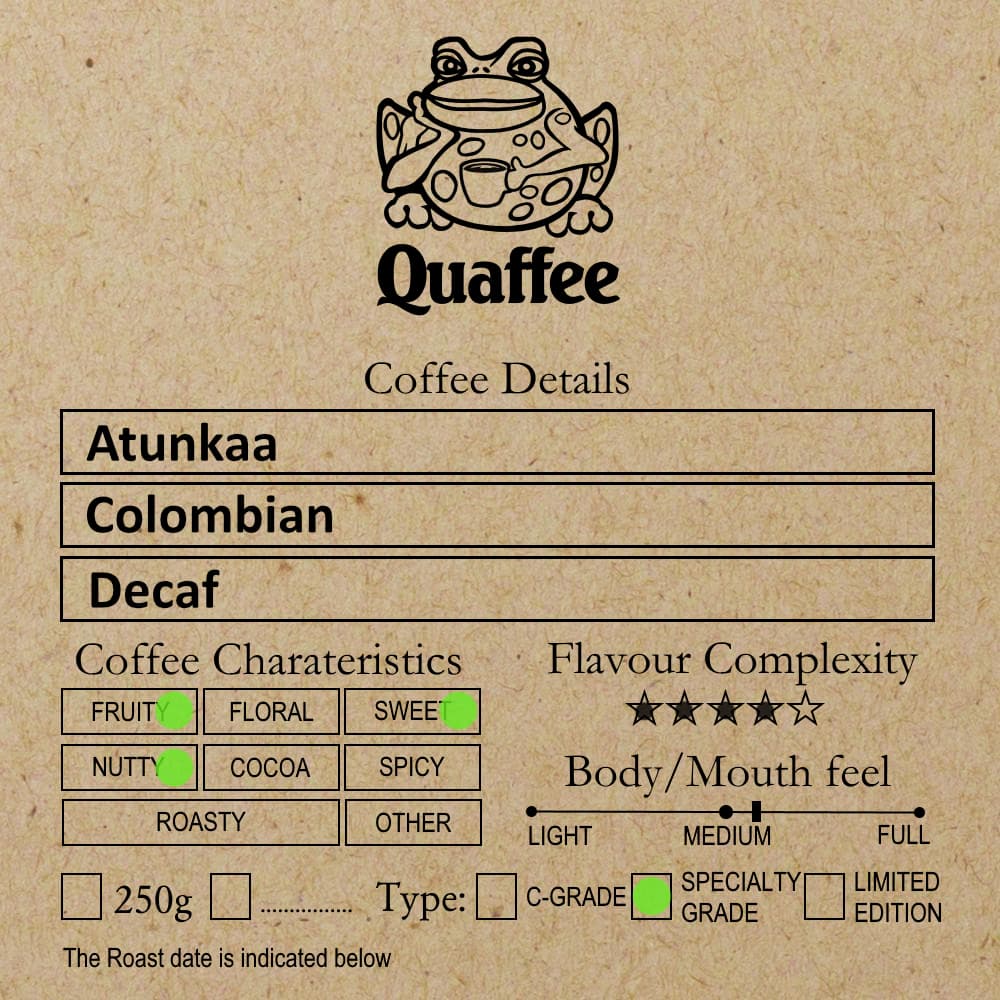
Colombian Atunkaa Decaf
Atunkaa is a community-focused coffee project that works with coffee-growing families in Colombia. This lot brings together coffees grown by smallholder farmers across producing communities and is designed to maintain traceability, consistency and quality while supporting long-term producer relationships.
The coffee consists primarily of traditional Colombian Arabica cultivars, including Castillo, Caturra, Bourbon and Tabi. These varieties were selected for their resilience, productivity and cup quality. Farms supplying the lot are generally located between 1,680 and 2,050 metres above sea level.
After harvesting and washing, the coffee undergoes sugarcane decaffeination. This method removes caffeine using naturally derived ethyl acetate produced from fermented sugarcane. The process preserves much of the coffee’s original sweetness and structure, which helps the final cup retain its origin character.
Expect a clean, rounded cup with caramel sweetness, soft citrus acidity and notes of toasted coconut. The body remains smooth and balanced, making it suitable for both filter and espresso brewing.
For roasting, this coffee performs particularly well as a light to medium roast. Lighter profiles highlight citrus and sweetness, while slightly more developed roasts bring forward caramel, almond and brown sugar characteristics.
Coffee Details
| Region | Antioquia, Colombia |
| Farmers | Smallholder producer groups and community lots |
| Cultivars | Arabica (Castillo, Caturra, Bourbon, Tabi) |
| Altitude | 1,680–2,050 masl |
| Processing | Originally, a washed process, dried before sugarcane ethyl acetate decaffeination |
| Packaging | GrainPro-lined bags |
| Primary tastes | A medium bodied coffee with orchard fruit, brown sugar sweetness and a nutty finish. |
| Roast used | Gentle ramp rate with a slowing after first crack to promote sweetness. |
| Roast degree | Light (124) – using my-tonino.com |
Our brews:
Just a note on this coffee. We found grind size needed to be slightly coarser than normal for the brew. Using your “standard” grins size for your brew will cause over extraction of the coffee. If you find you brewing times extended then change the grind to be coarser.
| Brew Method | Ratio | – | Brew Method | Ratio |
|---|---|---|---|---|
| Espresso | 1:2.3 (22 sec) | AeroPress | 17.5g:200g (medium-coarse grind) | |
| Plunger | 50g:800g | Pour over/filter | 17.5g:300g (coarse grind 50 sec bloom, 3.5 min total brewing time) |
Transparency Information
| Producer / Organisation | Atunkaa and Descafecol |
|---|---|
| FOB price | $12.57 |
| Cupping score | 84.5 (And sons) |
| Lot size bought | 1 x 70 kg bag. |
| Relationship | Our relationship with And Sons goes back half a decade. |
Sources
• Falcon Coffees – Information on Colombia’s coffee history, farming structure, production environment and Antioquia growing region.
• And Sons Importers – Information on the Atunkaa coffee project, decaffeination method and coffee details.

Reviews
There are no reviews yet.