


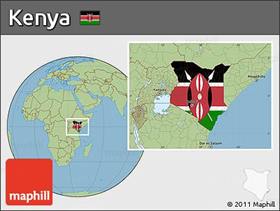

Kenya
Coffee arrived in Kenya in the late 19th century through European missionary routes. Although it sits next to Ethiopia, coffee did not take root here until much later. Since then, Kenya has developed one of the most structured and quality‑focused coffee systems in the world. Cooperative societies play a central role in processing and market access, and this structure helps maintain high standards.
Kenya produces mainly Arabica, much of it grown by smallholder farmers who cultivate only a few hundred trees each. Because farms sit on high volcanic slopes with cool temperatures and steady rainfall, cherries ripen slowly. This slow development creates dense beans with bright acidity and layered fruit notes.
Kirinyaga County
Kirinyaga sits on the southern and eastern slopes of Mount Kenya. Elevation ranges from around 1,400 to 2,000 metres. Consequently, temperatures stay cool, rainfall remains steady, and cherries grow slowly. This combination encourages sweetness, acidity, and clarity in the cup.
The region’s deep red volcanic soils drain well and offer high mineral content. Because of this, trees produce dense beans with vibrant aromatics. Kirinyaga farms are usually small, often less than one hectare, and most growers deliver their cherries to cooperative‑run wet mills. These mills maintain strict sorting standards, which further sharpens the region’s reputation for citrus brightness, red‑berry notes, and clean finishes.
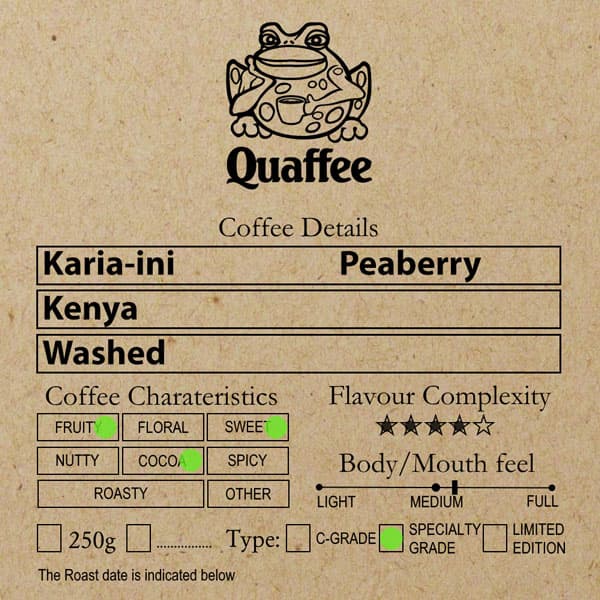
Kenya Karia‑Ini Peaberry
Karia‑Ini Factory operates under the Mwirua Farmers’ Cooperative Society in Kirinyaga County. Around 507 smallholder farmers deliver cherry to this wet mill. Most farmers grow SL28, SL34, Ruiru 11, and Batian on small plots, often intercropped with food crops.
The factory sits at roughly 1,600 metres. At this height, cherries ripen slowly and develop sweetness and acidity in equal measure. Peaberries from this lot tend to show concentrated fruit character, especially blackcurrant, citrus, and red‑berry notes. A tea‑like finish often follows, shaped by the washed process.
A light to medium‑light roast suits this coffee. That approach helps preserve its acidity, keeps the fruit notes clear, and allows the sweetness to remain balanced.
Processing
- Farmers deliver ripe cherries to the factory.
- Staff sort and float the cherries to remove defects.
- A disc pulper removes the outer fruit within 24 hours of delivery.
- Beans ferment in water for 18–48 hours to loosen remaining mucilage.
- After fermentation, beans receive a clean water wash.
- Parchment dries on raised beds for 5–30 days, raked frequently for even drying.
- Once dried, the parchment rests before dry milling.
Kenyan Karia-Ini Peaberry Details
This coffee presents itself in the cup with peach, honey and nuts.
| Region | Kirinyaga, Kenya |
| Farmers | 507 smallholder members of Mwirua Cooperative |
| Cultivars | SL28, SL34, Ruiru 11, Batian |
| Altitude | ~1,600 masl |
| Processing | Fully washed and sun‑dried on raised african beds |
| Packaging | GrainPro |
| Characteristics | Peach, honey sweetness, nutty finish. Medium Body |
| Profile used | What we call a bump and kick with a gentle ramp down from first crack |
| Roast Degree | Light |
Our brews:
| Brew Method | Ratio | Brew Method | Ratio | |
|---|---|---|---|---|
| Espresso | 1:2.4 (27 sec) | AeroPress | 17g:200g (finer) | |
| Plunger | 48g:800g | Pour over/filter | 18g:300g (45 sec bloom, 3.5 total brewing time) |
Transparency Information
| Producer / Organisation | Eva Gotiti washing station |
|---|---|
| FOB price | $4.436 |
| Cupping score | 84(Zuka) |
| Lot size bought | 1 x 60 kg bag. |
| Relationship | We have been purchasing coffee from Zuka Green since their inception |
Sources
- Overview of Kenya as a coffee origin, including history, varieties, and smallholder systems.
- General production background, cooperative structure, altitude ranges, and farming culture.
- Information on Kirinyaga’s geography, climate, soils, and cup characteristics.
- Details on Kirinyaga altitude, soil type, and typical flavour profile.
- Karia‑Ini Factory source (from Zuka Coffee)
- Co-Pilot used for editing and final grammar check


Reviews
There are no reviews yet.