

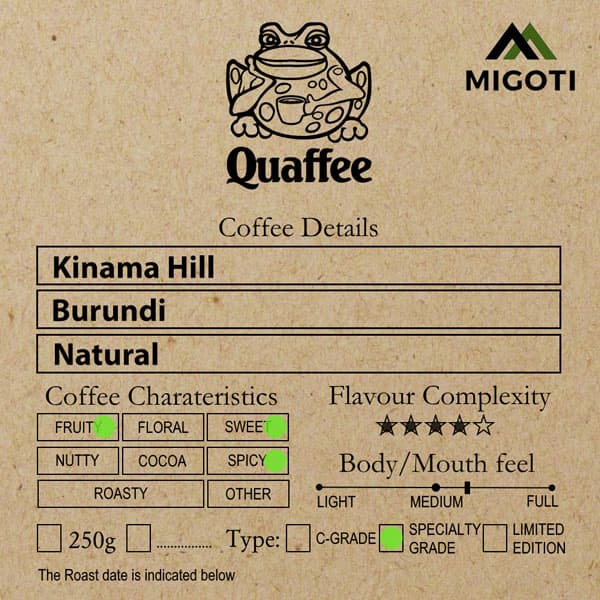




This Burundian Kinama Hill Natural is from Migoti coffee via Zuka Green.
Burundi
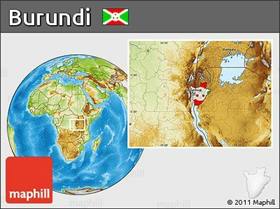
Burundi is a small, landlocked country in central-east Africa. It borders Rwanda to the north, Tanzania to the east, and the Democratic Republic of Congo to the west. Lake Tanganyika runs along its southwestern edge. Most of the country sits on a high plateau, with farmland ranging from around 1,200 to 2,000 metres above sea level — conditions that suit Arabica coffee well.
Burunian coffee
Coffee growing began in the 1930s, when Belgian colonial administrators introduced Arabica trees and required smallholder farmers to cultivate them. After independence in 1962, the new government maintained and expanded the industry, with World Bank support helping to build washing stations across the country. For decades, coffee was pooled into bulk lots and sold under the generic “Ngoma Mild” name — individual farms had no way to separate or market their own quality. That changed when the market liberalised, allowing washing stations to keep daily lots separate. That single shift opened the door to the traceable, high-scoring coffees that buyers now seek from Burundi.
From a cultivar standpoint, Bourbon dominates. This variety — which traces its lineage back to Réunion island — was the cultivar introduced under Belgian rule and has since adapted to Burundian altitude and soil over several generations. The most common variants are Red Bourbon and Jackson, a Bourbon-group selection introduced from India via East Africa in the early 20th century. Grown at high altitude, these cultivars tend to produce coffee with bright acidity, noticeable sweetness, and a full body — characteristics that set Burundian coffees apart from Ethiopian or Kenyan origins.
Today, an estimated 600,000 to 800,000 smallholder families grow coffee in Burundi. Most tend fewer than 250 trees on small plots of land, often intercropped with food crops. Coffee remains the country’s most important export by both volume and value, averaging around 26,700 tonnes per year, though output varies considerably between seasons.
Migoti Coffee
In 2015, two engineers, Dan and Pontien, embarked on a mission to modernise Burundi’s coffee industry. Founding Migoti Coffee Company, they aimed to link local farmers with global buyers through high-quality processing and transparent supply chains. Leveraging their engineering expertise and deep roots in the community, they sought to drive economic transformation using coffee as a catalyst.
After overcoming challenges like the civil war’s impact on coffee farming and the isolation of farms from processing facilities, they launched a modern washing station in 2016. This sparked renewed investment in coffee cultivation among local farmers. Beyond coffee, Dan and Pontien are innovating with projects like a small hydropower plant and exploring new crops like essential oil plants, further empowering the community and enhancing sustainability.
Migoti now works with over 1,200 smallholder farmers across the highlands of Bujumbura Province. The company buys cherries directly from farmers and manages processing, drying, and export. Around 10 permanent staff and over 250 seasonal workers run the stations, with the seasonal workforce predominantly women who oversee sorting and the drying tables.
Beyond production, Migoti supports farmers with agronomic training, coffee seedlings, and access to international markets. In 2023, the company also introduced a micro-financing programme to help farmers invest in their farms without resorting to cash advances from independent traders.
Quaffee has been offering Migoti Coffee since 2018, and we look forward to working with them in to our future.
Bujumbura Rural Province
Bujumbura Rural Province sits in western Burundi, wrapped around the city of Bujumbura and rising east into the highlands above Lake Tanganyika. The province spans three distinct natural zones: the lowland Imbo plain near the lakeshore, the steep Mumirwa highlands running north to south along the continental divide, and the higher Mugamba plateau to the east.
Farms sit in the Mumirwa zone — a narrow, steep highland strip that follows the Nile-Congo watershed. Elevation here ranges from roughly 1,500 to over 1,900 metres. The terrain is sharply hillside: farms occupy steep gradients, and most work — planting, pruning, picking, and delivery — is done by hand. Days are warm, nights cool. Annual rainfall is moderate at roughly 1,200mm, falling across two wet seasons that align well with the coffee tree’s growth and cherry development cycle.
The soils in Mumirwa are a mix of sand, loam, and clay, with a reasonable organic content from years of shade planting and cover cropping. Farms overlooking Lake Tanganyika also benefit from the lake’s moderating effect — a relatively stable microclimate that reduces the temperature swings common in more inland highland areas.
Kinama Hill
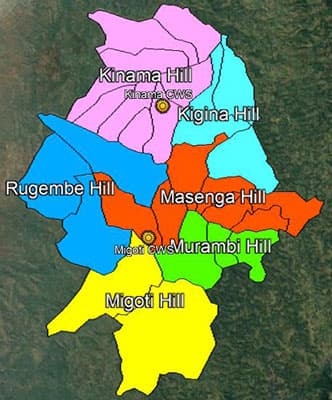
Kinama Hill is one of the collection areas served by Migoti’s Kigini washing station. The station was built in 2022 specifically because the distance between these hillside farms and the main Migoti station — around 4 kilometres — was long enough to affect cherry quality in transit. Bringing the station to the farmers reduced that window and improved what arrived at the drying beds.
The hill sits at approximately 1,665 metres above sea level. Farmers here are smallholders growing Red Bourbon on steep plots. Lots from Kinama Hill typically represent between 500 and 2,000 individual farms, depending on the season’s cherry volume and how the station separates daily deliveries. Lot 11 is a discrete micro-lot — a specific day separation kept apart for its cup profile.
In its first operating season, the station had no wet mill, so everything was processed as natural. That wasn’t by design but by necessity — there wasn’t sufficient water on site for washed production. A wet mill was added in 2023. Even so, the natural lots from Kinama attracted strong interest and remain a deliberate part of what Migoti produces here.
In the cup, Lot 11 sits in an interesting place. The fruit is ripe and present — blueberry, stone fruit, sweetness — but it doesn’t tip into the heavier fermentation notes that some naturals carry. It behaves almost like a clean washed coffee in terms of structure, with natural processing adding sweetness and depth rather than funk. That quality is partly the cultivar, partly careful drying management.
Details of Burundian Kinama Hill
Starting brews:
| Brew Method | Ratio | Brew Method | Ratio | |
|---|---|---|---|---|
| Espresso | 1:2.2 (27 sec) | AeroPress | 17.5g:200g (2m steep) | |
| Plunger | 48g:800g | Pour over/filter | 18g:300g (or 20g for more spice) |
Transparency Information
| Sourced from | Migoti via Zuka Trading |
|---|---|
| FOT price | U$D 4.25/lb FOT Bujumbura |
| Cupping score | 84 (ours) |
| Producer / Organisation | Migoti Coffee Co-operative |
| Lot size bought | 3 x 60kg bags |
| Relationship | We have had a working relationship with Dan Brose, the part-owner of Migoti, since 2019. This is our sixth season dealing with Dan. His son Andrew has taken over the day-to-day operations now. |
Images
From Dan Brose – Migoti coffee, Image with Zephyrin and Pontien taken at the Mogiti event in Cape Town, photographer Cuth Bland.
Sources:
- James Hoffman’s World Atlas of Coffee.
- Migoti Coffee’s website and coffee information.
- Wikipedia.
- Editing assistance by Anthropic Claude




Reviews
There are no reviews yet.